
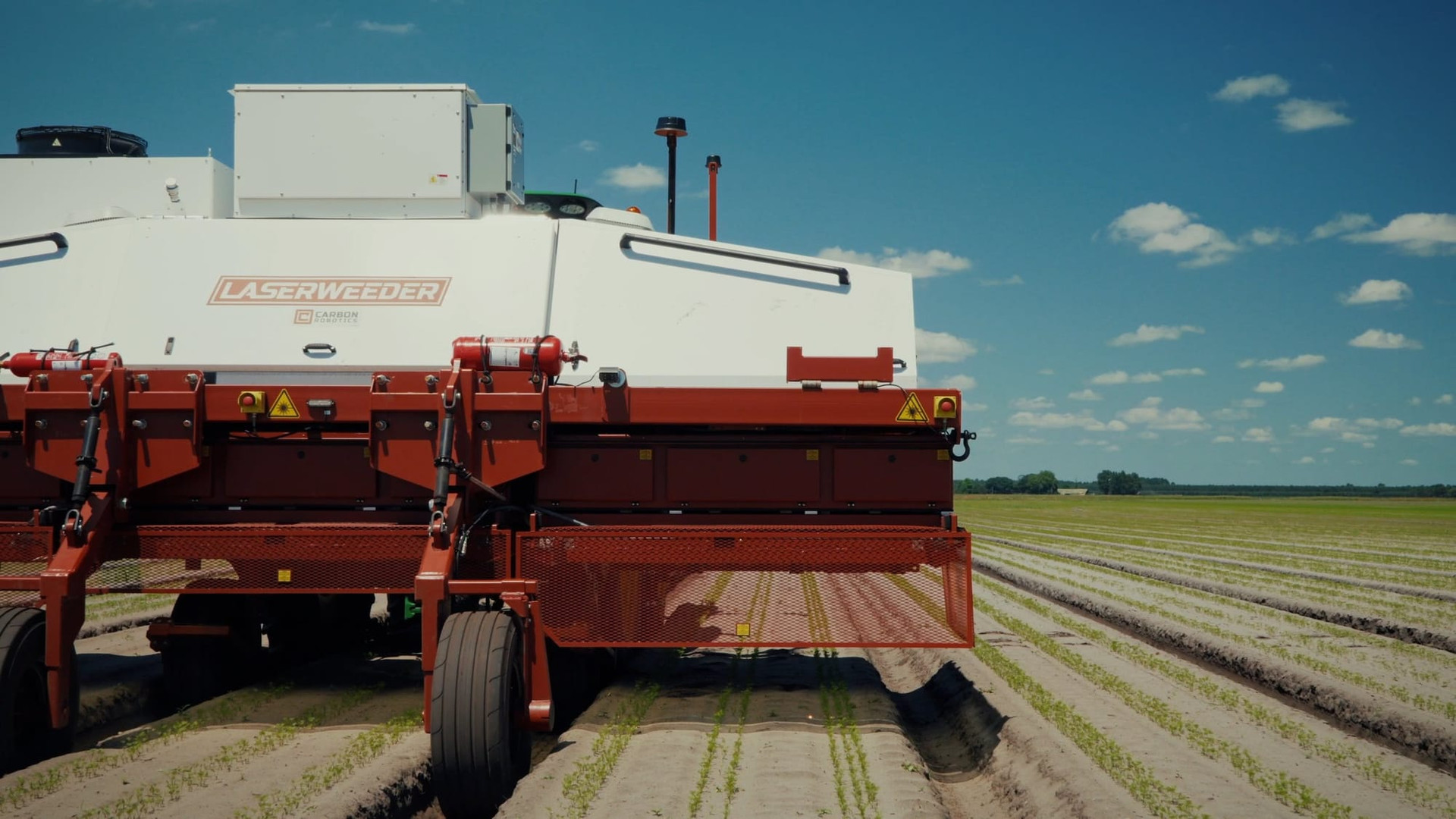
A robotic weeder is only as good as the plants it has been taught to recognise. Show most of them a new crop, a new weed, a different field, and you are waiting weeks or months while someone trains a fresh vision model for it. Out in the paddock the weeds keep growing the whole time.
What the Large Plant Model changes
That lag is what Carbon Robotics says it has closed. In early February 2026 it launched what it calls the Large Plant Model, an AI trained on roughly 150 million labelled plants across diverse crops, weeds, soils, climates and growth stages. The pitch is simple to state and hard to build: one model that recognises any plant in any field straight away, instead of a separate vision model trained per crop the way the rest of the industry does it.

Where Carbon Robotics gets its training data
Where the training data comes from is the bit that matters. Not a lab. Carbon's own robots, already out earning their keep across roughly 14 to 15 countries and more than 100 farms. Every pass adds labelled plants to the pile, the pile makes the model sharper, the sharper model sells more robots, and round it goes. A weeding-hardware company has effectively become an agricultural-data company, and the data only its fleet can gather is the bit a rival cannot easily buy.
What does that buy a grower? A feature called Plant Profiles lets an operator point an iPad at a new field, pick two or three photos, and have the robot adapting in minutes. The same brain runs both the LaserWeeder robots and the new Carbon Autonomous Tractor Kit that retrofits tractors you already own.
The LaserWeeder G2 still has to land the shot
The hardware still has to land the shot. The flagship LaserWeeder G2 carries 30 of those 150-watt diode lasers and 42 cameras across a 20-foot bar, firing at more than 5,000 weeds a minute at sub-millimetre accuracy, with up to a 99 percent strike rate and weed-control costs cut by as much as 80 percent. CEO Paul Mikesell says the model lets robots understand any plant in any field immediately and adapt in real time. The launch ran alongside demos at Fruit Logistica in Berlin and World Ag Expo in California, plus a reported 20 million dollar Series D round led by Giant Ventures.
For a high-value horticulture grower here, the onions, the organic row crops, the vegetable blocks where herbicide resistance and seasonal labour both bite, the change is worth weighing. A robot that adapts to a new block in minutes rather than months is a different machine than the one growers were quoted two years ago, even though the lasers have not changed. The real advantage moved into the data, somewhere a buyer never sees and a competitor cannot quickly replicate.
Source: The Robot Report. Image: Carbon Robotics.
We track the Australian used and new equipment market and publish what we find, in plain language, for the people actually buying and selling machines.